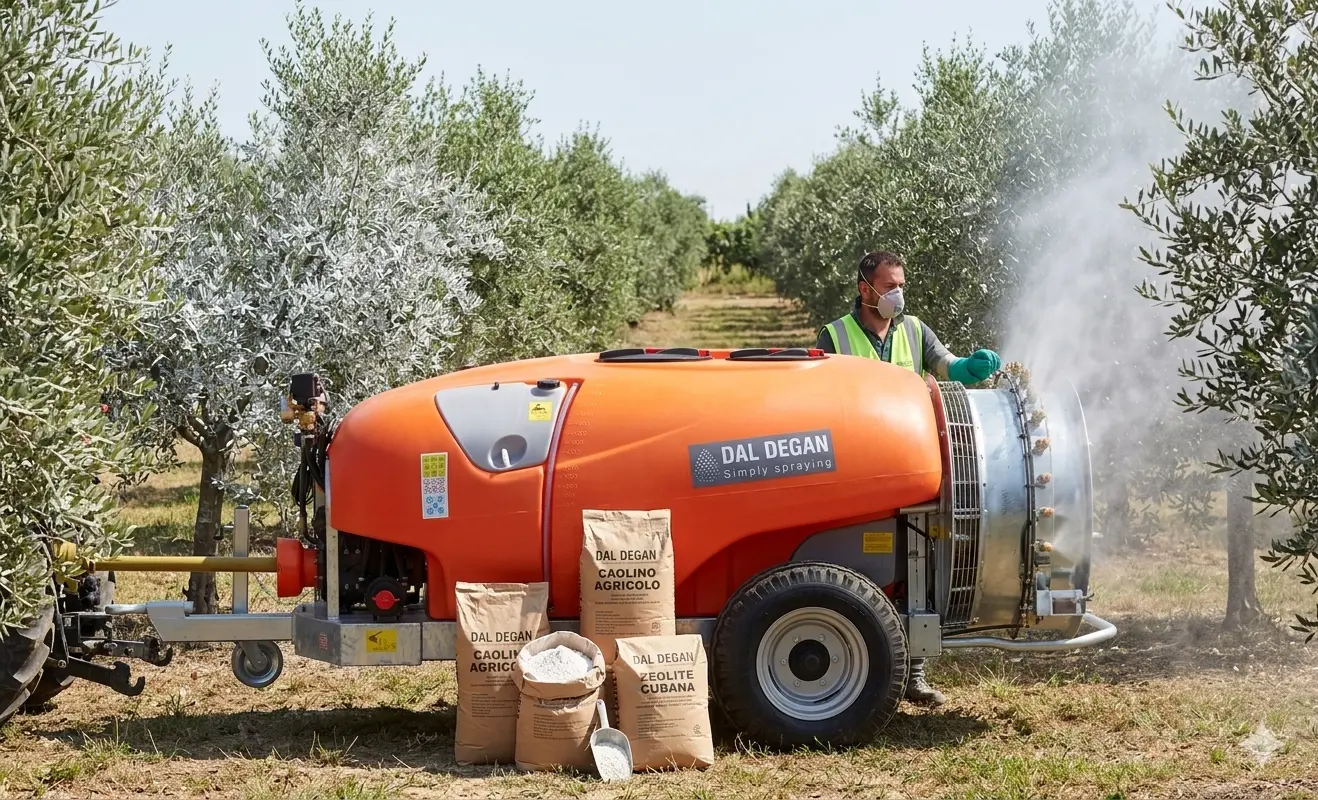

Blog how to choose a sprayer

How to choose a tractor-mounted sprayer for vineyards and orchards: 2026 practical guide

Summary

Choosing the right tractor-mounted sprayer is one of the most important technical decisions for anyone managing a vineyard or orchard. Equipment that is well-calibrated to the farm’s characteristics—crop type, terrain morphology, tractor power, and row spacing—makes a significant difference in terms of phytosanitary coverage, operational efficiency, and management costs. Conversely, the wrong machine wastes product, strains the tractor, and leaves untreated areas that become breeding grounds for pests and diseases. In this guide updated for 2025, we examine the main types of sprayers available on the market, the fundamental parameters to evaluate, and the most suitable configurations for different systems: trellis vineyards, wide-canopy orchards, and young plantings.

Mounted or trailed? The basic distinction

The first choice to make concerns the connection to the tractor. Mounted sprayers attach to the tractor’s three-point hitch and generally have tanks ranging between 200 and 800 liters. Since they do not have their own wheels, the weight rests entirely on the vehicle; therefore, the choice must consider the tractor’s lifting capacity. Their main advantage is compactness and maneuverability: they are ideal for hillside vineyards, terraced land, and narrow rows where a trailer would struggle to turn. On steep slopes, a mounted sprayer on a crawler or isodiametric tractor is often the only safe choice. Trailed sprayers travel on their own wheels and offer tanks from 500 up to 3,000 liters. Thanks to the chassis, the weight does not rest on the tractor, allowing for much larger volumes to be loaded and reducing refueling stops. They are the natural choice for large farms on flat land, where the autonomy of a high-capacity tank significantly accelerates treatment cycles. However, they require more maneuvering space at the end of the row and sufficiently powerful tractors.

Fan: axial, centrifugal, or tower

The fan is the heart of the sprayer: it determines the ability to penetrate the canopy and reach the innermost and highest parts of the vegetation. The axial fan (propeller type) is the most common in viticulture and fruit growing due to its robustness and simplicity. It produces a wide and steady airflow, effective in most situations. The centrifugal fan (turbine type) generates a more concentrated and powerful jet, suitable for tall crops or those with very dense canopies where air needs to be pushed deep inside. It is the typical solution for cannon sprayers used on large trees. The tower head is a vertical configuration that directs the airflow upwards along the row. It is ideal for high trellis vineyards and fruit walls (fruit wall, super-intensive apple orchards), as it distributes the product uniformly from top to bottom across the entire leaf wall. A major advantage of the tower is the reduction of drift: by directing the jet directly onto the vegetation, lateral dispersion is limited, which is important both for treatment efficacy and the protection of neighboring crops.

Tractor-sprayer pairing: power matters

A sprayer that is oversized for the tractor works inefficiently, consumes more fuel, and can be dangerous on sloping ground. Practical guidelines for pairing:
  • Up to 45 HP: light mounted sprayer with 200–400 L tank and 500–700 mm fan
  • 50–70 HP: medium mounted sprayer of 400–500 L or trailed up to 1,000 L
  • 75–120 HP: large mounted sprayer of 500–800 L or trailed up to 2,000 L
  • Over 120 HP: large trailed sprayers up to 3,000 L, multi-row solutions, high-flow centrifugal systems
These values are indicative: power consumption also depends on the pump flow rate and fan diameter, not just the tank volume.

Fan diameter and canopy height

The maximum height of the plants to be treated is one of the most important parameters in the selection. The taller the canopy, the larger the fan diameter—and its airflow—must be to push the product to the top.
  • Canopies up to 3–5 m (vineyards, dwarf orchards, young plantings): 500–700 mm fan
  • Canopies of 5–6 m (stone fruits, medium-height olive groves): ~800 mm fan
  • Canopies of 7–8 m (citrus groves, traditional unpruned olive groves): ~900 mm fan
  • Over 8–9 m (walnut, chestnut, poplar, monumental olive groves): 1,000 mm fan or adjustable centrifugal cannon systems
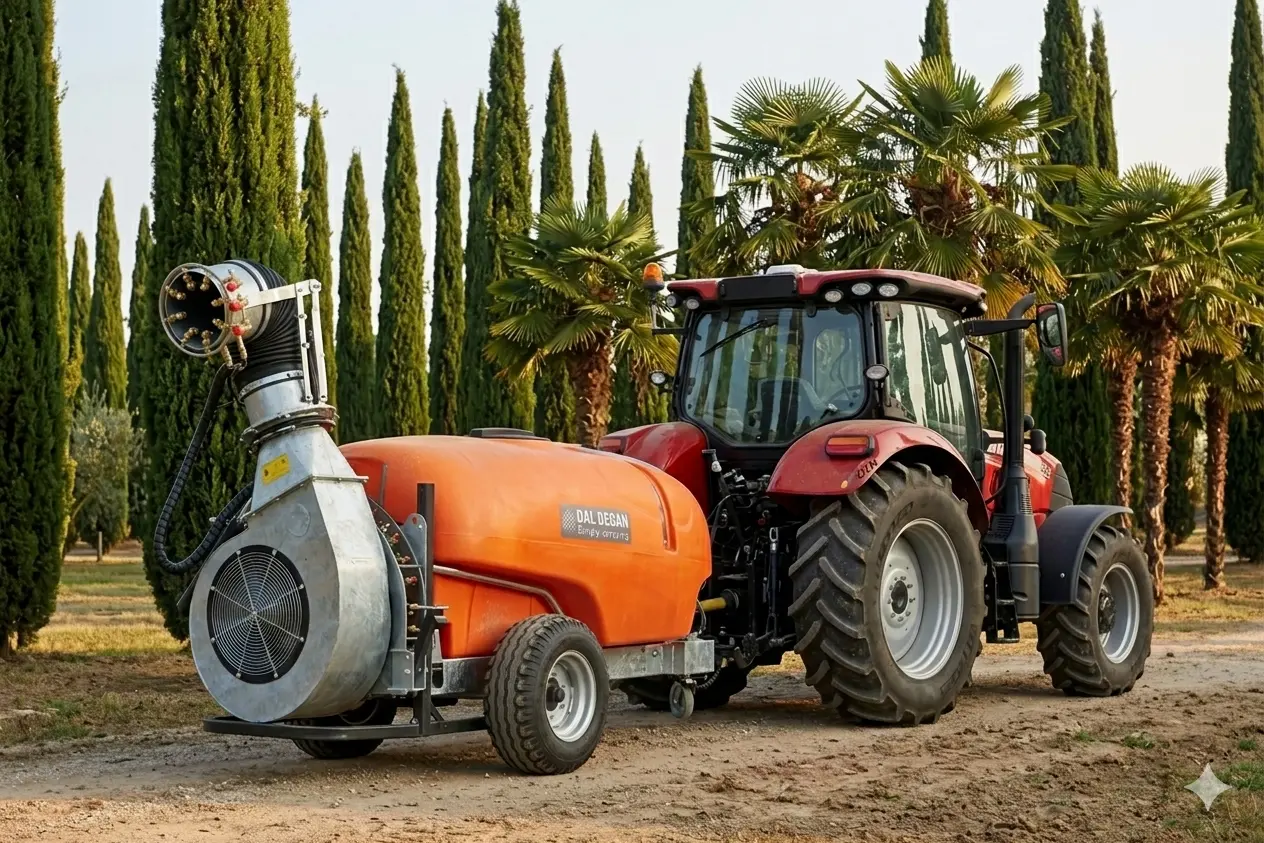
Not only the fan size but also its design should be considered: two large fans of the same diameter but different designs can have very different airflows. Always check the vertical reach declared by the manufacturer and compare it with the actual height of your plants.

Trellis vineyard: agility above all

The classic trellis vineyard features closely spaced rows (2–3 m row spacing) and a vertical leaf wall 1.5–2 m high. The main challenge is to uniformly cover both sides of the row without affecting adjacent ones and without damaging the shoots during passage. For hilly or fragmented vineyards, the most common solution is a 300–500 L mounted sprayer with a ~700 mm axial fan, mounted on a specialized narrow-track tractor. On steep slopes, a crawler tractor ensures stability. Adding a tower head to this type of machine further improves vertical coverage and reduces drift. For large flat vineyards, a 800–1,500 L trailed sprayer with a ~800 mm fan accelerates treatments by reducing stops. Some models with an articulated chassis follow row curves better. There are also multi-row sprayers capable of treating two or three rows simultaneously, with additional arms or lateral diffusers: in large, regular vineyards, they can halve intervention times. A practical rule to understand if coverage is sufficient: during treatment, the leaves should move slightly under the airflow. If they do not move, the air is not penetrating the canopy—and the product is not reaching the inner leaves. Discover the Dal Degan range of vineyard sprayers: mounted and trailed models with various fan configurations, suitable for every type of planting, from hillside to lowland.

Wide-canopy orchard: power and uniformity

In pome fruit orchards (apple, pear), stone fruits (peach, cherry, apricot), olive groves, and citrus groves, the canopies are more developed in height and width compared to vines. The typical configuration for these systems is a 1,000–2,000 L trailed sprayer with an 800–900 mm fan, paired with a tractor of at least 80–100 HP. For vertical wall orchards—super-intensive apple orchards, fruit wall orchards—the vertical tower is the most effective solution: it distributes the product uniformly across the entire height of the canopy, from the low-hanging fruit to the leaves at the top, while simultaneously reducing drift toward the outside of the row. For olive or citrus groves with trees over 6–7 m in height, an adjustable centrifugal cannon sprayer may be necessary, capable of launching the jet high while remaining at the edge of the row. However, this solution requires favorable weather conditions (no wind) and very precise calibration to avoid drift. An often underestimated tip: adapt the airflow to the season. In spring, when the canopy is still sparse, less flow is needed; in mid-summer, with dense vegetation, maximum penetration is required. Machines with adjustable fan speeds allow for the optimization of treatment at every phenological stage, reducing waste and improving coverage. The Dal Degan trailed models for orchards are available in various capacities and fan configurations, with high-flow pumps and efficient agitators to keep even the densest products in suspension.

Young plantings: delicacy and precision

In newly planted vineyards and orchards, requirements change radically. The saplings are low, have little foliage, and are delicate: an oversized sprayer can damage them with excessive wind or waste product on the wide empty row spacing. The ideal choice is a small mounted sprayer (200–300 L) on a light tractor, with a few nozzles targeted at the rows, reduced fan speed, and limited pressure. A light tractor compacts the young soil less, a significant factor in the early years of the planting. If a large machine intended for mature plantings is already available, it can be adapted: by closing some nozzles, lowering the fan speed, and applying shielding to limit the jet directly onto the saplings. The goal is to distribute less volume per hectare but with greater frequency if necessary, as young foliage dries quickly and must be protected with regular coverage.

Calibration, maintenance, and safety

Whichever sprayer is chosen, the effectiveness of the treatment depends significantly on calibration. Adjust flow rate, pressure, and nozzles based on forward speed and leaf density. Recalibrate every season or crop change. Before starting treatments, test the machine with water: verify that every nozzle sprays correctly, that the fan reaches the intended speeds, and that there are no leaks. For maintenance, clean and check filters and nozzles regularly: a partially clogged nozzle compromises uniform distribution without being immediately visible. Check the condition of the pump and seals, and lubricate the fan gears according to the manufacturer’s instructions. Regarding safety, with mounted sprayers, always verify the vehicle’s balance with a full tank and apply front ballast if necessary. When going downhill with heavy trailed units, maintain an appropriate speed and use the trailer brakes in a coordinated manner. Always wear PPE during mixture preparation and machine washing at the end of the day.

Conclusions

Dal Degan has been manufacturing mounted and trailed sprayers for vineyards and orchards since 1870, at its headquarters in Breganze, in the province of Vicenza. Every machine is designed for the actual operating conditions of Italian and European vineyards and orchards. Consult the full range of Dal Degan sprayers or contact us directly for support in choosing the model best suited to your farm and crop.
Share
Related Articles
Categories

Discover the Dal Degan product range

Browse all categories of agricultural machinery and professional spraying systems, designed to ensure efficiency and reliability in field operations.
Contact us

Contact the Dal Degan team

Do you need product information?

Explore the Dal Degan product range

Find the right product

Explore the Dal Degan product range

Find the right product

DAL DEGAN will be exhibiting at EIMA 2026

Hall 37 – Stand C16

Bologna, Italy | 10–14 November 2026