

Anyone who has tall cypresses in their garden or manages rows of tall trees knows that phytosanitary treatments on trees exceeding 6-8-10 meters represent a real challenge. A backpack pump is not enough: a manual jet rarely reaches the upper parts of the canopy uniformly, and climbing a ladder with a sprayer on your back is neither convenient nor safe. Yet neglecting the tops of the trees means leaving free space for pests, fungi, and scale insects that often settle right at the top, where they are least disturbed.
In this guide, we look at how to effectively and safely tackle the spraying of cypresses and other tall trees — poplars, palms, monumental olive trees, walnuts, chestnuts — from preparing the mixture to choosing the right time, through to using the Dal Degan Ulisse mounted mist blower, specifically designed to reach canopies up to 10 meters high while remaining comfortably on the ground.
Which plants require specific equipment
The problem of vertical reach affects all crops and ornamental species exceeding 4-5 meters. In agricultural and ornamental contexts, the most common situations are:- Cypresses in windbreak rows, hedges, or isolated ornamental specimens
- Palms in coastal gardens or urban parks, often at risk from the red palm weevil
- Poplars and forest plants in production sites or extensive green areas
- Monumental olive trees with canopies expanded in height and width
- Walnuts and chestnuts in production or in private and public areas
- Tall ornamental trees in gardens and urban avenues (linden, plane trees, cedars, sequoias)
Preparing the mixture correctly
Before starting any treatment, preparing the mixture is the fundamental step to ensure effectiveness and safety. Always read the product label. Every pesticide, fungicide, or foliar fertilizer specifies the exact dosage in ml of concentrate per liter of water. Adhering to these instructions is not just a matter of effectiveness: a concentration that is too low will not protect the plant, while one that is too high can cause phytotoxicity or unnecessary waste. Fill the tank in the correct order. For concentrated liquid products, first pour half of the water into the tank, then add the concentrate, and finally top up with the remaining water while mixing well. For powder or granular formulations, first pour in all the water and then gradually add the product, stirring so that it dissolves without forming lumps. This order ensures a homogeneous distribution of the active ingredient throughout the mixture. Filter if necessary. If the product contains particles that are not completely soluble, use the funnel filter during filling to avoid nozzle blockages. The Ulisse mist blower is equipped with a self-cleaning suction filter that significantly reduces the risk of clogging during work — a practical detail that makes a difference during long sessions on many trees.The right time: weather conditions and schedules
Choosing when to treat is as important as knowing how to do it. Atmospheric conditions directly influence the product’s effectiveness and the risk of drift, especially when working on tall trees where the mist travels a longer trajectory before settling. Avoid the hottest hours. In full sun and with high temperatures, the mixture evaporates rapidly before settling on the canopy. The best time is early morning, after the dew has dried, or late afternoon-evening, when the sun goes down and temperatures drop. Foliage must be dry before treatment: never spray on plants wet with rain or dew. Absence of wind. Wind is the number one enemy of spraying on tall plants. Misted droplets are light and easily diverted, dispersing the product away from the target. Choose calm days or days with minimal breeze. If there is a light breeze, position yourself upwind of the trees so the airflow helps carry the mist toward the canopy. The powerful fan of the Ulisse generates a directed flow that limits lateral dispersion compared to a manual sprayer, but wind must always be kept under control. No rain in the following 24 hours. Rain after treatment washes away the product before it can act. Check the forecast: at least 24 hours of dry weather are needed after application. Mild temperatures. The optimal range for most treatments is between 10°C and 25°C. Below 5-8°C, many active ingredients lose effectiveness; above 30°C, the risk of phytotoxicity increases. In winter, if you must treat — for example with mineral oils against scale insects — choose the central hours of the day when the temperature is relatively higher.The Dal Degan Ulisse mist blower: reaching the top without ladders
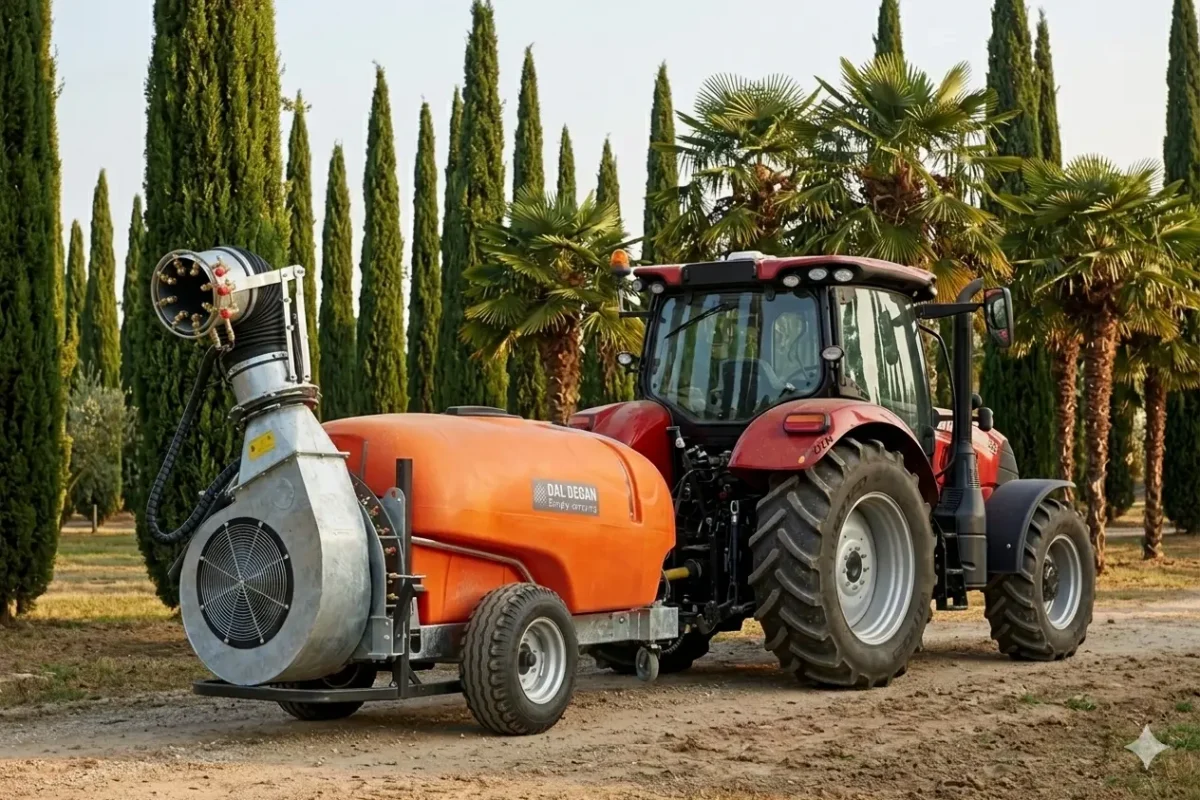
To treat trees 8-10 meters tall effectively and safely, the solution is the Dal Degan Ulisse mounted mist blower: a cannon atomizer connected to the tractor, designed specifically for intensive treatments on tall plants such as cypresses, palms, and ornamental trees.Main technical features
The Ulisse is available with a 400 or 600 liter tank and features a high-performance axial fan that generates enough airflow to push the misted mixture up to 10 meters in height. The diaphragm pump is driven by the tractor’s power take-off (recommended speed ~540 PTO rpm), so it requires no manual effort: you sit on the tractor while the machine works for you. The conveyor — the “cannon” from which the mist emerges — is adjustable in both rotation and inclination, allowing you to adapt the direction of the jet to the height and shape of each tree without having to reposition the tractor for every pass. This makes it as versatile for narrow, vertical cypresses as it is for trees with expanded canopies like olives and walnuts. The brass anti-drip nozzles prevent dripping when the spray command is interrupted: no product loss between trees, less waste, more precision. The frame and conveyor are made of galvanized steel, a robust construction designed to withstand intensive use and prolonged exposure to phytosanitary products. Compared to a backpack pump or a manual sprayer, the Ulisse allows you to cover large areas in significantly less time: no stops for manual pumping, no ladders, no unreachable top zones. For those managing tree-lined avenues, parks, or rows of windbreak cypresses, the saving in time and effort is immediate and substantial. You can view the full technical data sheet for the Ulisse on our website.How to use the Ulisse on cypresses and tall trees
After connecting the mist blower to the tractor and filling the tank, position yourself 5-6 meters away from the base of the tree: this distance allows the mist to expand correctly before reaching the canopy, ensuring a more uniform distribution than getting too close. Start the fan and the pump, aim the cannon toward the top of the tree, and begin spraying from the top down. This order prevents falling droplets from re-depositing on areas yet to be treated. Proceed slowly along the perimeter of the tree or along the row, keeping the jet aimed and the movement constant. For isolated trees — single cypresses, palms, monumental olive trees — rotate around the plant spraying from at least two opposite sides to ensure that the inner part of the canopy is also reached. The air pushed by the fan penetrates through the branches, carrying the droplets even into the innermost areas, which a manual pump would never reach. For rows and hedges of cypresses, proceed along the row at a slow and uniform pace, adapting the angle of the cannon to follow the shape of the trees. Slightly overlap each pass with the previous one to avoid uncovered areas.Techniques for uniform coverage
Regardless of the equipment used, the quality of the spraying depends on the technique. Here are the most important points. Constant speed. Neither too slow nor too fast: staying too long on the same spot accumulates too much product with a risk of dripping; proceeding too fast leaves areas uncovered. Find the right rhythm by observing the foliage: the leaves should be uniformly damp, not dripping. Visual check during treatment. Wet leaves darken slightly: observe this effect as you advance to verify that coverage is uniform. If some areas remain light and dry, slow down or overlap with an additional pass. If you see drops dripping heavily from the branches, you are dosing too much at that point. Do not overdo the dose. More mixture does not mean more protection. The goal is to wet the canopy uniformly, not to saturate it. Small droplets well distributed over the entire surface is the correct result. Correct distance and angle. With a cannon atomizer like the Ulisse, spraying from a few meters away with the jet slightly tilted toward the top gives better results than getting too close. From a distance, the mist has room to expand and envelops the canopy better; from close up, you risk concentrating the jet on a few points, limiting overall coverage.Ulisse beyond cypresses: all tall trees
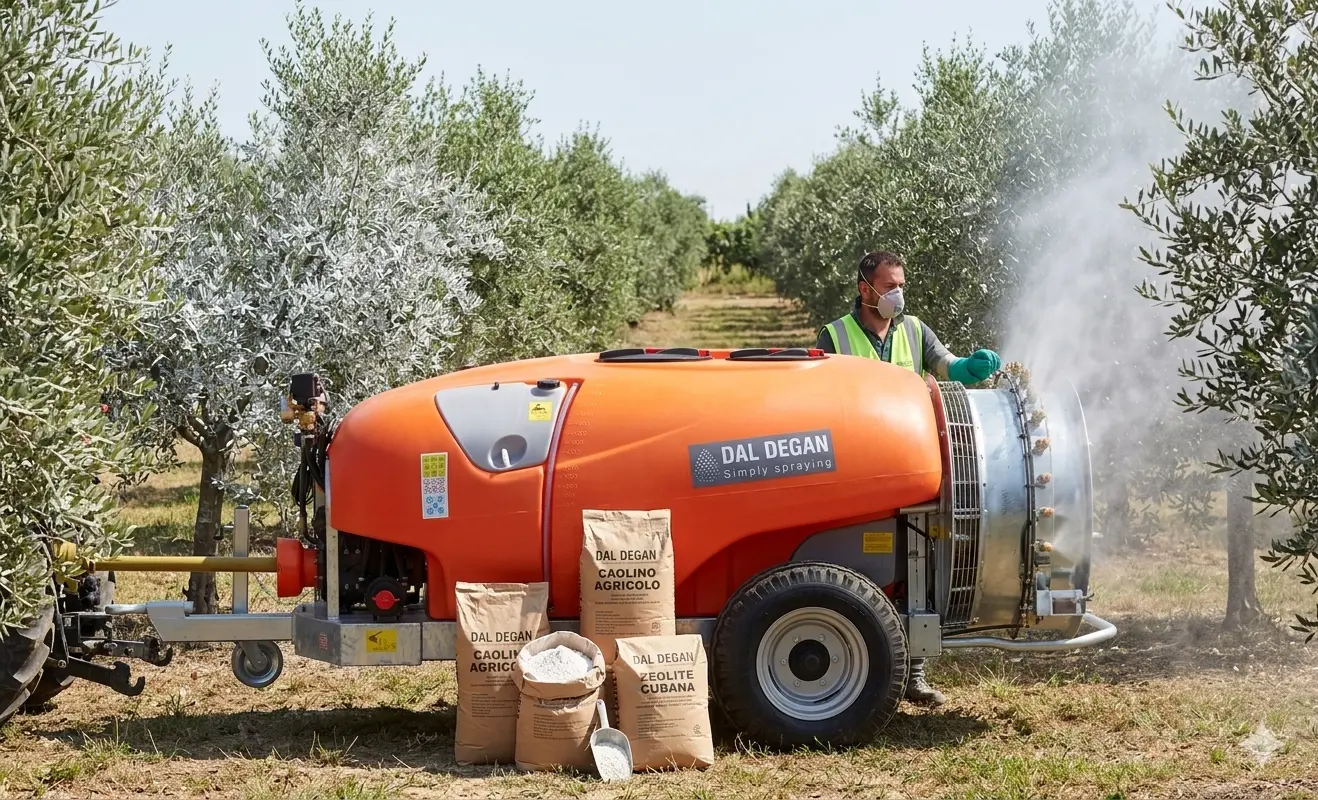
The same features that make the Ulisse ideal for cypresses make it effective on any plant requiring significant vertical reach. In agricultural and ornamental fields, the most frequent applications concern:- Palms: anti-red palm weevil treatments or other specific pests on canopies concentrated at the top of very tall trunks
- Poplars and forest plants: pest control treatments in production sites where working speed over large areas is fundamental
- Monumental olive trees: expanded canopies that require coverage in both height and width, with internal penetration difficult to achieve with traditional systems
- Walnuts and chestnuts: productive trees with very wide canopies that require significant air volumes to penetrate the internal vegetation
- Ornamental trees in public and private spaces: tree-lined avenues, parks, historic gardens where treatments must be precise and free of drift toward frequented areas