

Crop protection is undergoing a profound transformation. Regulatory pressure on chemical pesticides, the growing demand for organic products, and increased environmental awareness among farmers are driving the search for alternative, effective, yet low-impact solutions. In this scenario, kaolin and zeolite have emerged as two of the most interesting corroborants available on the market today: natural minerals, permitted in organic farming, which act through physical rather than chemical mechanisms to protect plants from insects, fungi, and thermal stress.
In this article, we delve into the characteristics of both, their pest control effectiveness, their effects on crop yield and quality, and the practical aspects of application—including the fundamental issue of distribution quality.
Kaolin: The Physical Barrier That Repels Insects
What It Is and How It Works
Kaolin is a natural white clay—technically an aluminum silicate—which, when sprayed on the aerial parts of the plant, forms a whitish powdery film. It is not an insecticide: it does not poison any pests. Instead, it acts as a mechanical repellent: the white surface alters the plant’s visual appearance, making it difficult for insects to recognize their host. Fine clay particles stick to legs, wings, and mouthparts, hindering movement, feeding, and egg-laying.
The result is that insects simply leave, preferring untreated plants. This purely physical mechanism has proven effective against a very wide range of pests: olive fruit fly, codling moth, pear and apple psylla, fruit fly, grapevine moths, leafhoppers, thrips, whiteflies, and many others. Research by the USDA has documented that plants treated with kaolin are virtually free from pear psylla infestations, while untreated crops in the immediate vicinity are heavily affected.
An important aspect: the action is preventive. Kaolin should be applied before or at the start of pest pressure—it does not eliminate already established insects, but prevents their establishment and proliferation.
Positive Side Effects: Less Heat, Higher Yield
In addition to insect protection, kaolin offers an often-underestimated benefit: thermoregulation. The white film reflects solar rays, particularly UV and infrared, lowering the surface temperature of leaves and fruits by up to 5–6°C during the hottest hours. This prevents sunburn on the fruit (known as sunburn), keeps stomata open, and reduces water stress on extremely hot days—conditions in which many plants slow down or stop photosynthesis.
This dual action translates into documented yield increases. In a study conducted on olive trees (cv. Zeity), trees treated with kaolin showed a production increase of +17.6% compared to the untreated control, with an estimated benefit-cost ratio of 3:1. Quality also improves: extra virgin olive oils from kaolin-protected olives show lower acidity, higher polyphenol content, and better shelf life. In vineyards, earlier ripening has been observed in treated vines compared to untreated ones.
Practical Aspects: Dosages, Limitations, and Costs
Kaolin is distributed in an aqueous suspension at 2–5 kg per 100 liters of water, uniformly covering the entire canopy to create a continuous film. It has no pre-harvest interval—it is inert and non-toxic—and residues on products are removed with a simple wash.
The main limitation is rain wash-off: intense precipitation washes away the film, making reapplication necessary. In years with average rainfall, 2–3 treatments are sufficient; in very rainy summers, this can increase to 4–5. The seasonal cost ranges between €200 and €700/ha depending on the number of interventions, but yield data shows that the investment pays off amply.
A warning: kaolin is not suitable for all crops. On brassicas (cabbage, turnips), it adheres poorly to waxy leaves. It can also mechanically interfere with beneficial insects such as pollinators and parasitoids, so in integrated pest management, it must be managed with careful attention to application timing.
Zeolite: The Leaf Microclimate Conditioner
What It Is and How It Works
Zeolite is a volcanic mineral with a microporous structure and extraordinary hygroscopic capabilities. Various types exist—clinoptilolite, chabazite—and those used in agriculture are chosen for their high cation exchange capacity and water absorption.
Applied to leaves in the form of micronized powder, zeolite absorbs surface moisture, creating a microenvironment unfavorable to the development of fungal pathogens such as powdery mildew, downy mildew, and botrytis, which require a film of water or high humidity to germinate and infect. It is therefore primarily a preventive physical antifungal: it does not poison the fungi but removes the necessary environmental conditions.
In organic vineyards, the use of chabazite zeolite has proven effective in controlling downy mildew and gray mold (Botrytis cinerea), especially during the critical pre-bunch closure stages. Zeolite also exerts a healing action on micro-lesions in plant tissues, hindering the entry of pathogens through wounds.
Against insects, the mechanism is different: the abrasive particles of zeolite adhere to the exoskeleton of arthropods, causing micro-abrasions on the protective waxy layer and absorbing their lipids, leading to dehydration. In experimental trials on rapeseed, 2–3 applications of clinoptilolite reduced damage from pollen beetles (Meligethes spp.) by 50% to 80% compared to the untreated control.
Zeolite in the Soil: A Long-Term Investment
A unique aspect of zeolite compared to kaolin is its use as a soil conditioner. Incorporated into the top 20 cm of soil, zeolite retains water (up to 30–60% of its own weight) and nutrients in the root zone, reducing leaching losses and improving fertilizer efficiency. Better-nourished and less-stressed plants are also more resistant to biotic attacks.
Unlike foliar treatment, soil conditioning with zeolite has a long-lasting effect over the years: once incorporated, it remains in the soil, progressively improving its structure. The investment is therefore spread over several production seasons.
Effects on Yield and Quality
The benefits of zeolite on yield and quality stem primarily from lower pest pressure and the improved nutritional status of the plants. In fields treated with clinoptilolite, an increase in rapeseed yield was observed compared to the untreated control, attributed to pest control and more intense flowering of the protected plants. In organic viticulture, the reduction of downy mildew and botrytis translates into healthier bunches, with fewer damaged berries and a higher commercial yield.
Zeolite leaves no visible or harmful residues at harvest time—it is a colorless natural mineral that washes off easily. This allows for treatments right up until harvest without residue issues, including a preventive pre-harvest intervention against botrytis.
Practical Aspects: Dosages and Compatibility
For foliar use, 2–5 kg/ha per application is used in aqueous suspension. Zeolite is compatible with most pesticides permitted in organic farming (copper, sulfur, Bacillus thuringiensis) and can enhance their synergistic effect. Compared to kaolin, it has greater resistance to wash-off, although intense rains still require reapplication.
Watch the nozzles: the siliceous nature of the powder is abrasive, so it is advisable to use metal nozzles instead of plastic ones to avoid premature wear.
The cost is around €2–5/kg, with a cost per foliar application of approximately €20–40/ha—very low compared to the benefits obtained.
Distribution Quality: The Decisive Factor
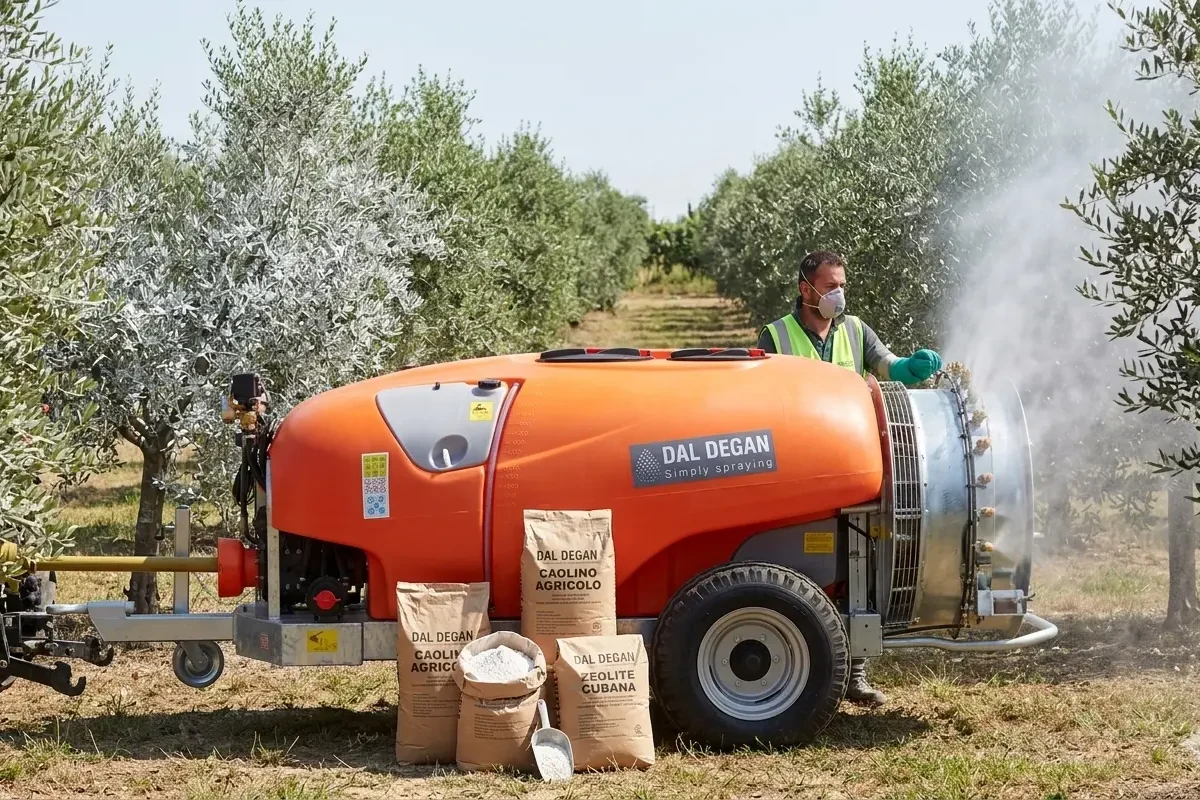
For both kaolin and zeolite, effectiveness depends critically on the completeness and uniformity of distribution. A discontinuous protective film leaves uncovered areas that pests immediately exploit. To build a truly effective coverage on upper and lower leaves, fruits, and new shoots, appropriate equipment is essential.
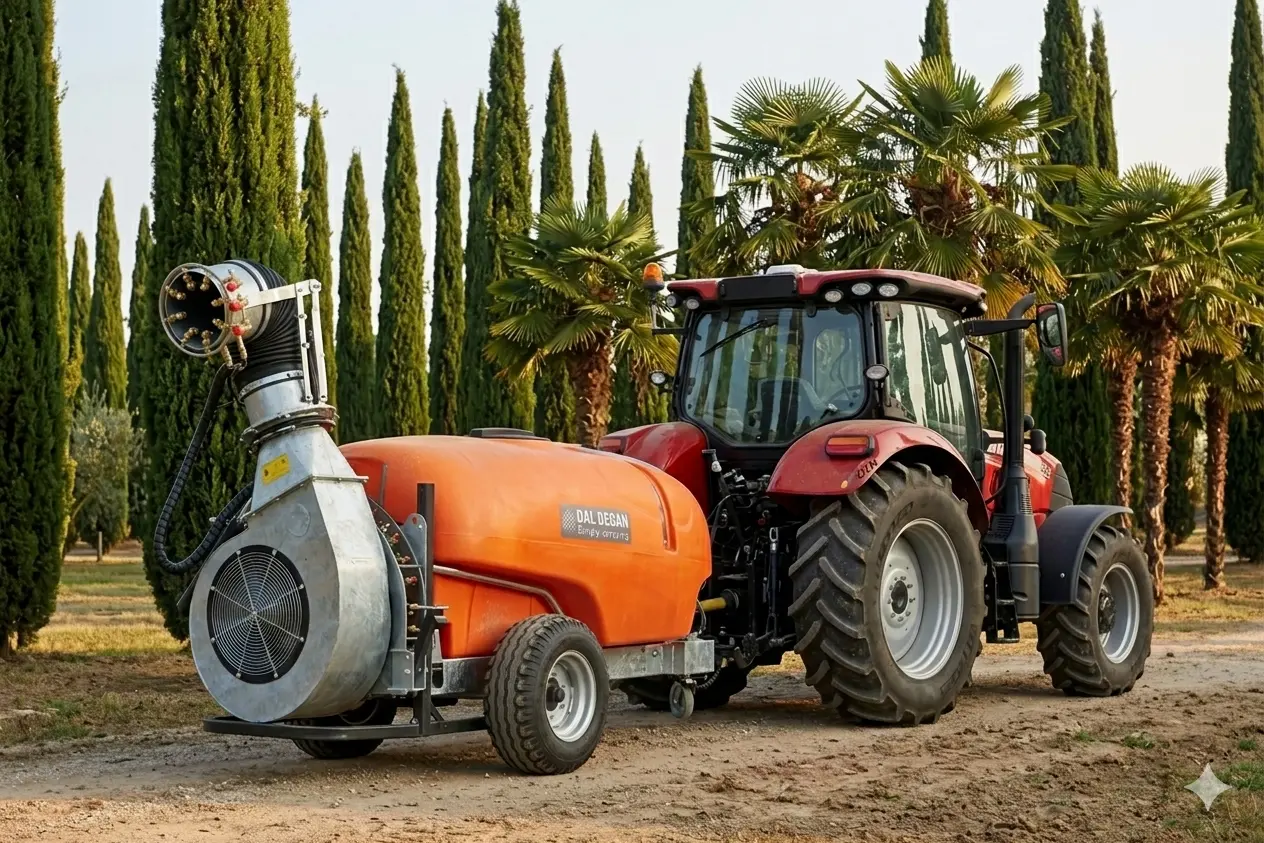
Dal Degan atomizers are designed to ensure precise and homogeneous coverage on every type of crop. The mounted range—from compact models for hillside vineyards to orchard atomizers—allows you to choose the right air volume and flow rate to reach every part of the canopy. I Trailed models, on the other hand, offer the capacity needed for medium and large farms, reducing treatment times over vast areas.
Homogeneous distribution not only maximizes the effectiveness of kaolin and zeolite but also reduces product consumption: fewer passes, less waste, and lower operating costs.
Conclusions
Kaolin and zeolite are concrete and scientifically validated tools for reducing pest pressure sustainably. They are not magic solutions—they must be part of an integrated strategy, applied preventively, and distributed correctly. But when used well, the data on effectiveness and economic return are solid.
For those working in organic farming or who simply want to reduce the use of chemical pesticides without sacrificing productivity, they represent an investment with real returns: less pest damage, less thermal stress, healthier fruit, and more stable yields.
With the right equipment—such as Dal Degan atomizers, built in Italy since 1870—their application also becomes simple, precise, and effective.
Want to know which atomizer is best suited for your crop?